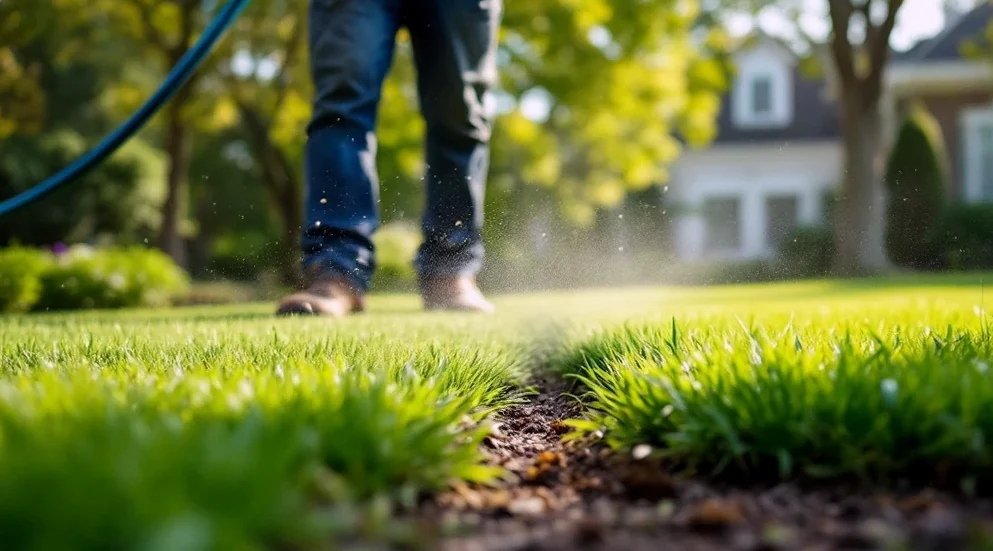
What is Hydroseeding Lawn Installation and how does it work?
Hydroseeding lawn installation is a process where a crew sprays a slurry of seed, fertilizer, mulch, and water onto prepared soil. It sticks to the ground, holds moisture, and germinates faster than dry seeding. For Huntsville clay soil, it's often the best way to start a new lawn.
The slurry is mixed in a tank on a truck or trailer. A pump pushes it through a hose, and the nozzle spreads it in an even coat. The mulch is usually wood fiber or paper based. It acts like a blanket, keeping seeds in place and slowing evaporation. On a hot Huntsville July afternoon, that moisture retention makes the difference between a lawn that comes up and one that bakes.
Dry seed blown onto bare dirt can wash into the street with the first heavy rain. Hydroseeding bonds to the soil. The mulch fibers tangle with the dirt particles and create a crust. That crust holds seed where it belongs, even on a sloped lot off Monte Sano Boulevard. You get a uniform stand of grass instead of bare patches at the bottom of the hill.
The seed mix can be tailored to your yard. Huntsville gets hot summers and cold snaps in winter. A common blend includes tall fescue for shade tolerance and Kentucky bluegrass for filling in thin spots. Bermuda is an option for full sun lawns. The slurry carries exactly the mix you need, no guesswork on spreading rates.
You see results in about 7 to 14 days. The first green fuzz appears as the seed germinates. The mulch holds moisture so you don't have to water constantly. After three to four weeks, you have a young lawn that can handle light foot traffic. Full establishment takes a couple months of regular watering and mowing.
Cost is lower than sod because there is no hauling and laying of turf. Hydroseeding covers a 5,000 square foot yard for roughly half the price of the same area in sod. The tradeoff is patience. Sod gives you an instant lawn. Hydroseeding gives you a lawn that needs a few weeks to mature.
How Hydroseeding Lawn Installation works, step by step
Hydroseeding lawn installation starts with site prep, then mixing the slurry, spraying it on, and following a watering schedule. Each step matters. Skip prep or water wrong and you waste your money.
First, we clear the area. Rocks, sticks, and old weeds have to go. A rototiller or a tractor breaks up the top four to six inches of soil. Huntsville clay is dense. If you skip tilling, the seed sits on hardpan and roots can't penetrate. The soil needs to be loose enough for a finger to push in an inch deep.
Next comes grading. You want water to run away from the house, not pool in the yard. A low spot near the driveway that holds water after a storm will drown the seed. We cut high spots and fill low ones. The grade should slope at least one inch per ten feet away from the foundation. This is the time to fix drainage issues, not after the grass is up.
We mix the slurry on site. The tank holds water first, then the mulch, then the seed and fertilizer. The mix is agitated constantly so it stays uniform. A typical load covers about 5,000 square feet. For a half acre lot, we might come back for a second load. The color is usually green, from a dye that helps you see where the spray has been.
Spraying takes about thirty minutes for an average yard. We start at the far end and work back toward the truck so we don't walk through wet slurry. The nozzle puts down a consistent layer. You want the ground to look like it has a thin coat of green paint. Too thin and the seed won't germinate. Too thick and the mulch smothers the seed.
After spraying, the critical part starts: watering. The slurry needs to stay damp but not soaked. Light watering twice a day for the first two weeks. Morning and late afternoon are best. A sprinkler that runs for ten minutes per zone is usually enough. If you see puddles forming, you are overwatering. If the mulch crust cracks, you are underwatering.
Mowing starts when the grass is three to four inches tall. Set the mower blade high. Scalping a young lawn sets it back weeks. After the first mow, you can reduce watering to every other day. By week six, the lawn is established enough for normal use.
Why Hydroseeding Lawn Installation matters for your home
Hydroseeding lawn installation matters because it gives you a thick, uniform lawn that controls erosion, cools the yard, and adds curb appeal. In Huntsville's clay soil and variable weather, it is more reliable than dry seeding and cheaper than sod.
Bare dirt around a new house or after a renovation turns to mud in the first rain. That mud runs into the street, clogs storm drains, and stains your driveway. Hydroseeding locks the soil down fast. The mulch mat holds the dirt in place while the roots establish. A lawn that goes in with hydroseeding stops erosion from day one.
A healthy lawn lowers the temperature around your house. Bare clay bakes in the sun and radiates heat back at your siding. Grass stays cooler. A 1,000 square foot lawn can cool the air around it by several degrees on a 95 degree Huntsville afternoon. That means your AC runs a little less.
Curb appeal matters if you plan to sell. A hydroseeded lawn fills in evenly, no patchy spots or bare areas. Potential buyers see a green yard and think the house was well cared for. A good lawn can add to the perceived value of the property. It is one of the cheapest improvements you can make that has a visible impact.
Hydroseeding also lets you choose the right grass for your specific yard. A shady lot under oaks needs a different mix than a full sun yard facing south. The seed blend is custom. You are not stuck with whatever sod the supplier had in stock. That custom mix means less maintenance and fewer weeds down the road.
The process is fast. A crew can prep and spray a typical lot in a single day. You are not waiting weeks for sod to arrive or for dry seed to germinate. Within a month, you have a lawn you can use. For a family with kids or dogs, that quick turnaround is a big deal.
Common problems and what causes them
Most problems with hydroseeding lawn installation come from bad soil prep, wrong watering, or poor timing. Seed washes away, germinates unevenly, or dies from disease. Each issue has a specific cause you can avoid.
Seed washing away is the most common failure. It happens when the ground is sloped and the slurry does not have time to bond. If you have a steep bank, we add a tackifier to the mix. Tackifier is a glue like substance that helps the slurry stick. Without it, a hard rain on a slope can send the whole job into the gutter. Huntsville gets gully washers in spring. If your yard slopes toward the street, ask about tackifier.
Uneven germination usually means the spray was too thin in some spots. The nozzle pattern can leave gaps if the operator is not careful. Good crews overlap each pass by half the spray width. If you see bare strips after two weeks, the coverage was inconsistent. This is why you hire a crew that does this full time, not a guy with a rental machine.
Damping off disease kills seedlings when the grass stays wet too long. Overwatering is the cause. The mulch stays soggy, fungus grows, and the young stems rot at the soil line. The fix is to water less often and let the surface dry between waterings. If you see patches of grass that look waterlogged and fall over, cut back on watering immediately.
Weeds pop up when the soil had weed seeds already in it. Tilling brings those seeds to the surface. They germinate alongside your grass. A pre emergent herbicide cannot be used at seeding time because it kills the grass seed too. The best defense is to kill existing weeds before tilling. If you skip that step, you will be hand pulling weeds for the first month.
Poor root growth happens when the soil is compacted. Huntsville clay is notorious for this. If you did not till deep enough or the soil was wet when tilled, it compacts again. Roots hit that hard layer and stop. The grass looks thin and struggles through summer. A core aeration the following spring can fix it, but it is easier to till properly the first time.
Birds eating the seed is rare but happens. The mulch usually hides the seed. If you see birds scratching at the lawn, spread a light layer of straw over the area. Straw breaks down and does not hurt the grass. Just make sure it is weed free straw, not hay full of weed seeds.
Common questions about Hydroseeding Lawn Installation
Need hydroseeding in Huntsville? Get a free estimate today.
📞 256-914-6298